Mekong delegates look to China's water wisdom at Three Gorges
On the sidelines of the 4th Lancang-Mekong Water Resources Cooperation Forum, high-level delegations from the Mekong countries traveled to Yichang, Hubei province, to explore the Three Gorges Dam, the world's largest hydropower project. For many, the visit was both a technical study trip and an eye-opening experience.
Chanthanet Boualapha (R), vice minister of agriculture and environment of Laos, is interviewed at the Three Gorges Dam in Yichang, Hubei province, Sept. 25, 2025. [Photo provided to China.org.cn]
"I am very pleased to learn that the Three Gorges Dam is the world's largest hydropower project," said Chanthanet Boualapha, vice minister of agriculture and environment of Laos. "It is a very useful dam for many purposes — navigation, flood control, irrigation, and of course electricity production."
Straddling the Yangtze River, the Three Gorges project is a multi-functional water-control system that includes a dam stretching more than 2,300 meters, five-tier ship locks on both its north and south sides, and 34 turbo-generators with a combined capacity of 22.5 million kilowatts.
For Boualapha, its lessons are highly relevant to the Mekong basin, where floods regularly threaten lives and livelihoods. "Every year we are faced with storms and flooding," he said. "Learning more about flood management and early warning is very useful for us so we can better prepare our people before floods come."
He added that the project's approach to maximizing hydropower generation could also serve as an inspiration. "It is important for us to learn how to use water effectively," he said.
Boualapha also highlighted the resettlement program for residents affected by the project, noting its strong focus on livelihoods through support for schools, hospitals, and industrial development. "A project like this is not only a technological marvel, but also a powerful driver of better lives," he said.

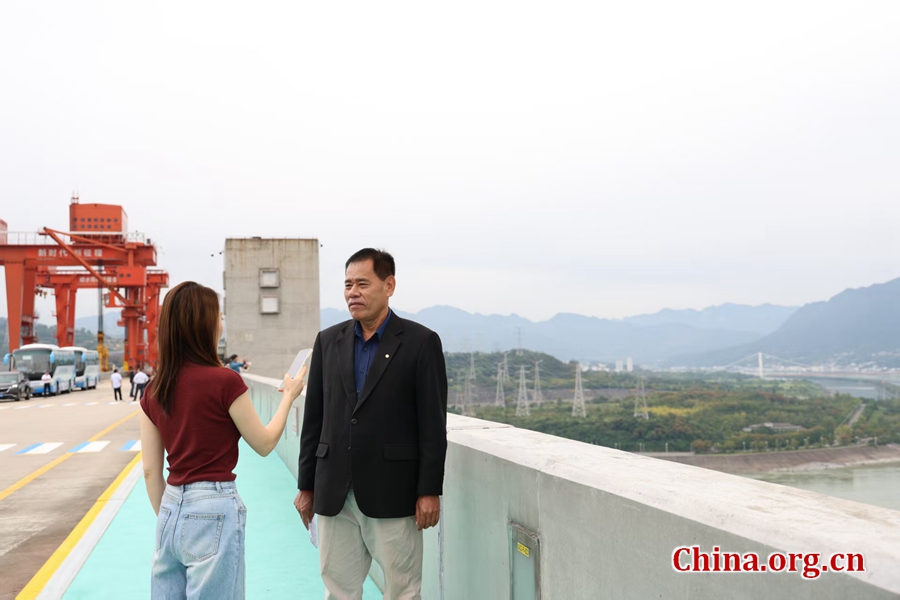
Surasri Kidtimonton (L), secretary general of the Office of National Water Resources of Thailand, is interviewed at the Three Gorges Dam in Yichang, Hubei province, Sept. 25, 2025. [Photo provided to China.org.cn]
Surasri Kidtimonton, secretary general of the Office of National Water Resources of Thailand, described his first trip to the dam as "really impressive."
"Beyond mitigating floods and producing clean energy, this reservoir also delivers water to Hanjiang river basin to ensure the water supply sources safety and other areas where demand is high, through the South-to-North Water Diversion Project," he noted, while the ship locks that allow vessels to bypass the massive structure particularly caught his attention. "That's a technology we can study and apply in Thailand."
At the Three Gorges Project Museum, Kidtimonton also learned how the project had worked to preserve rare plants such as the Chinese yew and dove tree, as well as endangered animal species like the Yangtze sturgeon. He said he hoped the Mekong countries could "better balance economic, social and ecological development" in their own water projects.

Zhou Zhiwei, secretary general of the Lancang-Mekong Water Resources Cooperation Center, visits the Three Gorges Dam in Yichang, Hubei province, Sept. 25, 2025. [Photo provided to China.org.cn]
For the Chinese organizers, the visit was also an opportunity to showcase their philosophy and approach to water management. "We invited representatives from the Mekong countries to see the dam firsthand so they could better understand China's philosophy and technology in water management, translating China's experience into policies and actions in their own countries," said Zhou Zhiwei, secretary general of the Lancang-Mekong Water Resources Cooperation Center.
He added, "Together we can raise water governance across the region and accelerate progress toward the UN 2030 water-related goals."
Zhou said participants were impressed by the dam's multi-functionality, as it incorporates flood control, power generation, navigation and irrigation. He added that many delegates expressed the hope that their own water agencies could learn from China's experience.
In fact, Lancang-Mekong water cooperation on capacity building is already well underway. Over the past few years, more than 180 students from Mekong countries have received full scholarships through the Chinese government's Silk Road program to pursue master's degrees in China. Zhou said that future efforts would aim to tailor training to specific national needs, combining Chinese expertise with local challenges.
Beyond human resources development, Zhou also pointed to the region's untapped water potential. Despite the Mekong's relatively abundant water resources — about 6,500 cubic meters per person annually, higher than both the Yangtze and Danube rivers — its current utilization rate stands at 13%, well below the other two basins, Zhou noted. This indicates that the region enjoys favorable water resource endowments, providing the conditions to promote sustainable development and improve livelihoods.
"Looking ahead, we need to work together to address the water challenges that come with modernization," Zhou said. "That means paying more attention to water saving, systematic governance, harmony between humans and nature, and the application of smart technology, and further implementing the Five-Year Plan of Action on Lancang-Mekong Water Resources Cooperation (2023-2027)."
He called for closer policy coordination among the six countries along the river, encouraging that more effective water cooperation outcomes can be achieved to help build "Lancang-Mekong Cooperation 2.0," characterized by unity and cooperation, openness and win-win outcomes, green innovation, and peace and tranquility.